Call for Submissions: Visual arts and writing competition, Forum on the energy and socio-ecological transitions
Can your artistic sensibility help us shed light on new perspectives on energy and socio-ecological issues?
The CEDAR project, NB Media Co-op and their collaborators invite amateur and professional artists to submit their visual or written works to a competition. The winning works will be published in a book launched at the Forum on the Energy and Socio-Ecological Transitions, which will take place at the Charlotte Street Arts Centre in Fredericton in October 2027.
CEDAR and partners hosted a visit to Fredericton and Moncton by Rodrigue Turgeon of Mining Watch Canada and an evening event in Fredericton with Alain Deneault, Université de Moncton à Shippagan.
The article about, and video of, their presentation was published by the NB Media Co-op, HERE.
Info on the Fredericton event is below:
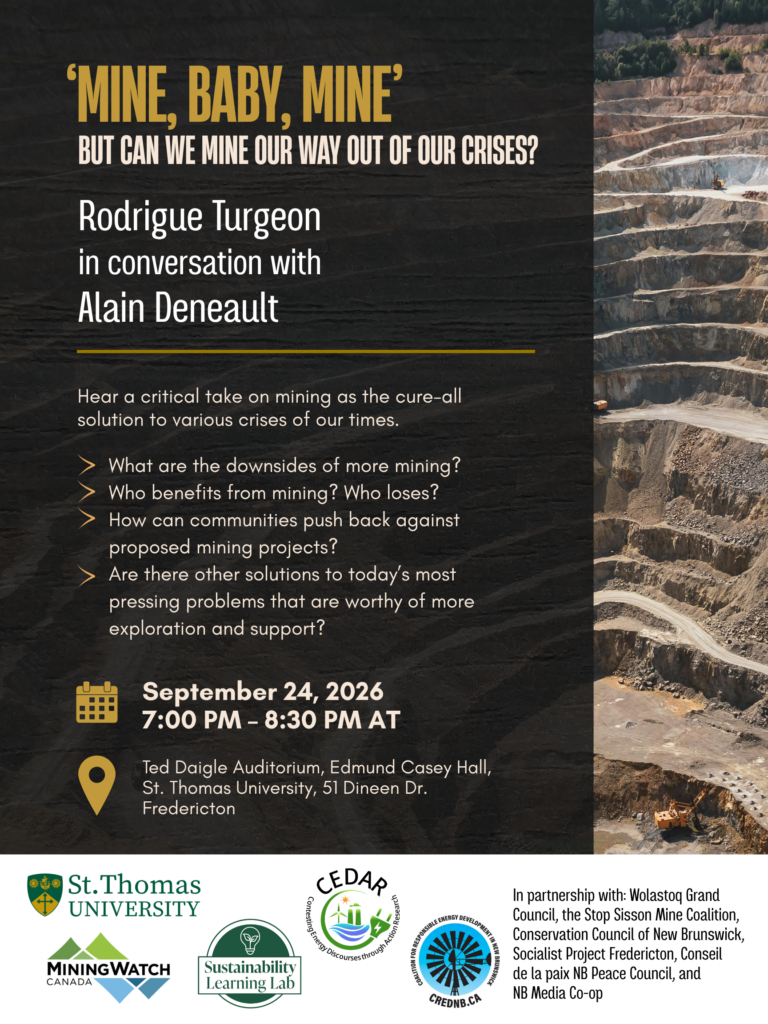
‘Mine, baby, mine.’ But, can we mine our way out of our crises?
Rodrigue Turgeon in conversation with Alain Deneault
When: Thursday, September 24, 2026, 7:00 PM – 8:30 PM AT
More mines – lithium, copper, nickel, tungsten, etc. – are being pitched as the solution to multiple problems – the economy, national sovereignty and security, and even the climate crisis. Mines are touted as nation-building projects and sources of critical strategic metals essential for national defense while the U.S. Department of War has pumped more than a total $78 million into different mines in Canada, including $15 million for the proposed Sisson tungsten and molybdenum mine, 60 km from Fredericton. Mines are also sources of transition metals needed for electric vehicles and renewable energy.
Hear a critical take on mining as the cure-all solution to various crises of our times. What are the downsides of more mining? Who benefits from mining? Who loses? How can communities push back against proposed mining projects? Are there other solutions to today’s most pressing problems that are worthy of more exploration and support?
Rodrigue Turgeonsupportsmany communities affected by mining across the country as the National Program Co-Lead of MiningWatch Canada. A lawyer from Abitibi-Témiscamingue, one of Canada’s most well-known mining regions, Rodrigue understands firsthand the social and environmental impacts of mining. Author of the bookNanikana, he holds a master’s degree in law and life sciences and a graduate degree in common law and transnational law, and is co-spokesperson of the Coalition Québec meilleure mine.
Hosts: Contesting Energy Discourses through Action Research (CEDAR), Sustainability Learning Lab and partners at St. Thomas University, Coalition for Responsible Energy Development (CRED NB), Wolastoq Grand Council, the Stop Sisson Mine Coalition, Conservation Council of New Brunswick, Socialist Project Fredericton, Conseil de la paix NB Peace Council, NB Media Co-op and MiningWatch Canada.
Atlantic Canada – Wabanaki homeland – has some of the most powerful winds in the world. Indigenous nations are developing partnerships to build wind projects that use this renewable energy source to generate revenue for their communities and contribute to meeting climate action targets while respecting Indigenous values.
The report was co-published by the Passamaquoddy Recognition Group Inc. and the CEDAR research project at St. Thomas University. Access it HERE.
In 2018, Canada published a strategic plan – a roadmap – to develop small modular nuclear reactors (SMRs) across the country. An SMR is one designed to generate 300 megawatts (MW) of electricity or less, compared to Canada’s existing CANDU power reactors which generate 500 MW or more.
According to the “SMR Roadmap,” the first demonstration SMR was expected to be operating in 2026. In this milestone year, our report analyzes the financial and developmental status of the 10 SMR designs with some kind of presence in Canada.
CEDAR researchers Susan O’Donnell and M.V. Ramana are finishing up a report on small modular nuclear reactors in Canada. On March 18 at 2 PM Atlantic, they will discuss their research at a webinar hosted by Nuclear Transparency Watch in Paris. Everyone welcome, more info and registration link HERE.
The CEDAR project was a co-host organizing the successful Social Forum in Wolastokuk in Fredericton in October. Research Assistants from all three CEDAR universities were engaged.
Mahus Dieuveille Samba, a Masters student in Environmental Studies at the Université de Moncton, was the CEDAR project’s photographer at the event. His photos can be viewed HERE and featured in the stories below.
Bahaar Abbas and Lilly Floerke both Masters students in University of British Columbia’s School of Public Policy and Global Affairs published a reflection on their experiences at the Social Forum, HERE.
The Social Forum reflection by Liam McDougall, major in Sustanability and Environmental Studies at St. Thomas University, was published HERE by CEDAR partner, the NB Media Co-op.
The CEDAR project is currently brainstorming ideas for the project’s next in-person meeting in Fredericton in 2027. These reflections from our Research Assistants will contribute to shaping the next event.
CEDAR and partners are co-hosting a book launch in Fredericton on November 26: Bad Indians Book Club by Patty Krawec.
Drawing on conversations with readers and authors, Bad Indians Book Club delves into writing about history, science, and gender, and into memoirs and fiction, all by “Bad Indians” and those like them, whose refusal of the dominant narrative of the wemitigoozhiwag (European settlers) opens up new possibilities for identity and existence.
NB Power, the public electrical utility in New Brunswick, is in a very difficult financial situation. The utility loses money almost every year, mostly due to the poor performance of the nuclear plant, and the major energy generators on its grid are either due in the next seven years for major repairs (Mactaquac hydro station), shut down (Belledune coal plant) or licence renewal (Point Lepreau nuclear plant).
What can be done about this situation? The province launched a review of NB Power in 2025. The Review Panel’s interm report, due in December 2025, has been delayed. The final report is due in March 2026.
The CEDAR project’s submission to NB Power Review team is available at the link below. CEDAR researchers believe NB Power needs a complete overhaul. Key messages:
The energy system – climate system connection is missing
There is a strong case against nuclear power as a climate-friendly supply option
Investing in new fossil fuel infrastructure is “moral and economic madness”
Global energy systems are transitioning to renewable energy, and NB Power needs to do the same
Renewable energy investments are already signalling the way forward in New Brunswick
Customers expect a public electrical utility they can trust; they are getting the opposite.
NB Power is frozen in the past. The utility needs a fundamental change of direction.
Wolastoq Grand Council and St. Thomas University: Wabanaki Student Center, Native Studies Department, CEDAR research project, Women’s Studies and Gender Studies, and Sustainability and Environmental Studies programs invite you to join us to hear from and engage with Sherri Mitchell. More info HERE.
A Conversation with Sherri Mitchell: How to be a good relative
Lakutuwakoneyak Kilun – We are all Treaty People – We are all related
Wednesday Oct. 29 3 PM
St. Thomas University Dawn Russell Lounge Sir James Dunn Hall
International energy expert Ralph Torrie, Research Director of Corporate Knights, has published his analysis for a renewable energy future for Maritime Canada. The CEDAR project and partners invited Ralph to New Brunswick to share his work with the public. 6 PM at the Fredericton Public Library. Info HERE.